 |
| CRV dash. |
 |
| Rav4 dash. |
 |
| CRV rear interior. |
 |
| Rav4 rear interior. |
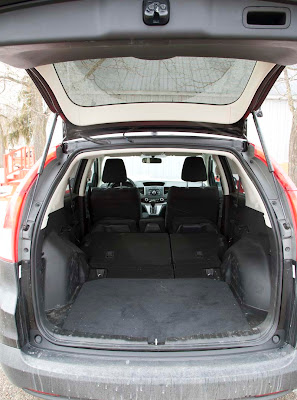 |
| CRV rear hatch area. |
 |
| Rav4 rear hatch area. |
Review by Jonathan Yarkony, photos by Jeff Wilson and Jonathan Yarkony
After several months in an Autos.ca Long-Term Test, a Test Drive last year and surviving three Comparison Tests (and winning one) we are plenty familiar with Honda’s CR-V. The Toyota RAV4, on the other hand, is new to the market just this spring and both dramatically changes from the previous generation while in some ways returns to its roots.
Both are now exclusively five-seat, four-cylinder, soft-roader crossover SUVs with optional AWD, just as they were when these nameplates were launched in the mid-nineties (okay, the RAV4 had those ridiculous two-door and convertible models, but lets just conveniently ignore those for the sake of symmetry, here). Both are also built in Canada, though that was not as significant a factor in their comparison as the fact that they have consistently battled in the sales charts, fighting for compact SUV shoppers that didn’t opt for the dominant Ford Escape. While the Escape dominates the Canadian compact SUV sales charts, the CR-V topped it in the States with over 280,000 units sold, but this year is trailing both the Escape and RAV4 in Canadian and American sales.
While we aim to have a more extensive comparison with new compact crossover offerings later this summer, we felt that these two have such a similar history and approach that we wanted to see how these traditional rivals (perhaps even ‘icons’ of the crossover breed) stacked up head to head. And despite a slight mismatch in trims, we feel that the essential qualities of each vehicle were present and accounted for, enough so that a fair and relevant evaluation can be conducted even with the varied option selections offering differences in character that serve to highlight the strengths of each vehicle and brand.
Features/Value: We were able to book an almost identically priced RAV4 during one of the last weeks of the CR-V’s residence, although they were not nearly identically equipped. Our CR-V is essentially a base model LX with one big feature, AWD, added on, taking the price to $28,140, plus a $1,640 destination fee and $100 excise tax for a grand total of $29,880.
The RAV4 we were offered came to $29,905, the difference less than the price of a family meal at Swiss Chalet. However, it arrives at that price over the base $23,790 LE FWD (score a point for Toyota for this low base price) as the $27,000 FWD XLE, $1,170 for the nav system (plus XM satellite radio and voice command), plus $1,635 destination and $100 A/C tax landing it at $29,905. For the equivalent of the CR-V’s base price ($25,990), the RAV4 can be had with AWD.
Feature for feature,
Honda at least has a slight edge in base-model equipment with an LCD display screen with radio data, voice command, driver armrest (vs a shared centre console armrest in the RAV4), a compass, heated driver and passenger seats, and a back-up camera. The RAV4 has wheel covers, which the CR-V does not. However, in this specific comparison, the RAV4 XLE FWD bumps the speaker count to six (from four), adds a sunroof, alloy wheels, dual-zone auto climate, 6.1-inch touchscreen display, heated front seats and premium cloth, cargo cover, variable intermittent wipers and a back-up camera, as well as the aforementioned nav system upgrade that also includes XM satellite radio and voice command. Without going all the way up to XLE trim, you can get the 6 speakers, 6.1-inch touchscreen display, tinted windows, cargo cover and back-up camera as a $1,000 upgrade package on the FWD or AWD LE trim.
Without question, the RAV4 provides more features at a better price.
Design Interior design is perhaps more subjective than feature counting, but despite Toyota’s efforts to liven up their interiors, they may have missed the mark. While I do like the essence of the layered dash and leather-stitched panel, it actually hides a row of buttons under its lip that made it hard for me to locate and reach the seat-heater switch.
Everything in the CR-V is easy to reach and clearly marked, although its basic features meant there was little to control relative to the RAV4’s navigation-equipped and touchscreen-controlled infotainment system.
And then there is the quality of materials.
The RAV4 interior is by no means Lexus quality, but it is clearly better than the CR-V, which is very much an economy car in its simplicity and basic materials.
The CR-V is awash in hard plastics, while the RAV4 is updated with quality materials, although they may have added one material too many in the tacky carbon-fibre-patterned shifter gate. Oh, and having a molded plastic imitation leather stitching on the steering heel hub right next to the genuinely stitched leather dash is just wrong.
My co-tester on evaluation day, Jeff Wilson, was turned off: “CR-V’s interior design is much cleaner and simpler – I greatly prefer it. By comparison, I counted at least ten different materials, colours or textures inside the wildly over-styled RAV4.”
Sometimes, simple is best.
But exterior design is not one of those times. How does the saying go? Fortune favours the bold. The RAV4’s creased and sculpted surfaces are eye-catching and it won Jeff over: “To my eye, the RAV4 is a much more attractive rig than the bulbous, awkward-looking CRV.” While I appreciate some details on the RAV4, particularly the crisp line that wraps around the front fenders, the nose seems too pointy, and the flat ‘shelf’ of the tailgate below the rear window is ungainly (though perhaps aerodynamically functional) and I see nothing to recommend it over the CR-V’s anonymous yet less fussy design. Despite my objections, I’ll concede to the majority as I have heard many others positive comments about the RAV4’s interior and exterior design.
However, one other oddity or oversight of the RAV4’s design is the placement of the tailgate handle right below the rear window – it’s just too high, which makes it harder for anyone, but especially shorter people, to lift the tailgate. Perhaps this is a product of Toyota’s recent switch to the vertical tailgate instead of the side-hinged door, but the CR-V’s handle is conveniently located at the very bottom of the tailgate just above the bumper.
A quick note about safety: The 2013 RAV4 has yet to be rated by the IIHS or NHTSA, but we expect that it will match the CR-V’s Top Safety Pick and Five Star Overall ratings.
So, the RAV4’s design seems to make a better first impression, as does interior quality, but the CR-V is quietly a very smart package without any real marks against except dullness.
Utility These two cars are incredibly closely matched in size and interior dimensions, so it could be a wash, but it’s not. While the RAV4 is slightly larger in every exterior dimension (but within 50 mm/a couple inches in length, width and wheelbase),
the CR-V makes the most of its barely smaller footprint with better interior space in most measurements except front legroom and headroom. The one dramatic advantage for the CR-V is in rear hip room, 1,349 mm to the RAV4’s 1,242. That 107 mm (over 4 inches) makes a difference. After testing day, I set up both my car seats in each car, and asked my wife to test the middle position. While the CR-V is tight, it is tolerable for short distances. The RAV4 did not even have sufficient space for my wife to squeeze in between the two car seats, and she is smaller than most average North American teenagers. Without car seats, the RAV4 is also a bit tighter, but still functional.This time around, I finally found a
sucker, er, I mean volunteer to perform the car-seat installation test, and this is what Jeff – also the father of a toddler – found: “Slightly easier to locate the LATCH anchor points in the CR-V than in the RAV. Plus there’s no need to remove head rests for installation in the CR-V and the backrest angle lines up for a perfectly flush mount with the car seat. Also, the rear doors of the CR-V open much wider than RAV4’s. This is especially useful for loading and unloading bulky items – like toddlers or their car seats.”
Front seat comfort for parents was good in both, but I personally preferred the softer texture of the CR-V seat fabric, and Jeff points out that the well-positioned driver’s seat armrest in the CR-V makes long distance driving more relaxed and comfortable.
The cargo areas are within 100 L of each other with seats up or down, with the RAV4 slightly more accommodating, not only in measurement but also in my “Canadian dad cargo test”. In the pictures with my hockey bag and our son’s stroller, note how the stroller had room to lie flat in the RAV4, where we have to turn it on its side in the CR-V. The RAV4 also has a cargo cover for those looking to hide their goods from prying eyes, and the floor is flush with the plastic trim above the bumper, where the CR-V has a lip, making it easier to slide heavy objects into the RAV4.
However, the CR-V counters with the useful ability to drop the rear seats from the back cargo area (RAV4 requires going to each rear door opening and accessing a lever at the top of the seatback to do so). Still the RAV4’s slightly larger cargo area isn’t enough to outweigh the more accommodating and flexible CR-V interior. Ride With these two vehicles in our possession, we took the opportunity to get away from the urban and suburban confines of our usual test loop and headed north, aiming for cottage country. Between gas stops, a quick wash (yes, believe it or not we washed the cars, as fruitless as that was since it started snowing and kicking up slush the minute we left the car wash), and photography, we only made about halfway to our intended destination before hitting our cutoff time. Still, we meandered through the suburban outskirts of the GTA, then traversed some horribly maintained country highways, and even found a steep gravel sideroad with a fair dusting of snow.
Out here, we had a chance to pick apart the ride of these two vehicles, and this provided one of the biggest surprises.
The RAV4 was rough. The suspension was simply too firm, leading to a jittery ride, and brakes that seemed a touch grabby. Yes, the steering was sharp and the responsiveness was good, but it did not come off as sporty, just rough and twitchy. It’s like Toyota has forgotten all about the gazillions of customers who have flocked to it for that pleasant, novocaine ride and aimed to please a few overeager enthusiasts. Granted, it is better overall than the previous generation, which seemed completely lost whenever making a turn, but this seems to have taken the sportiness need too far, even going so far as to offering a ‘Sport’ button to remap transmission and throttle – I doubt that will really appease all those V6 loyalists Toyota claimed with the last RAV4.
The CR-V was a complete softy and absorbed washboard roads with minimal fuss in the cabin aside from a generous serving of noise. Everywhere else, the CR-V demonstrated supreme comfort without feeling sloppy in the corners. To go back to our first Crossover Comparison Test, in which the CR-V proved victorious, “The nearly perfect ride balance between comfort and sport is unexpected in this class of vehicle and the steering wheel sends a surprising amount of feedback to the driver.” And when arriving at your destination, both have a reasonable turning circle (though the RAV4’s is slightly better), and both were equipped with back-up cameras in this test, with reasonable visibility out of the side windows and the same restrictive D-pillars to work around. No real advantage here.
Almost everything about driving the CR-V feels just right, while the RAV4 seems to have confused firmness with sport. And, of course, with Honda having spent its upgrade budget on AWD, it also offered superior traction in slippery conditions (hey, if the RAV4 gets points for all its features, the CR-V deserves a nod here). We don’t doubt that the RAV4 would have equaled the CR-V for traction capability if so equipped, and even in FWD configuration, still pulled away smartly after traction control took over and meted out appropriate engine and wheel braking, further convincing me I have no need for AWD. Others may feel differently. Suit yourself.
Powertrain Now that both the RAV4 and CR-V are on an even footing offering exclusively inline-fours, we knew this powertrain category was going to be one of the most closely contested. Could the CR-V’s 2.4L 185 hp edge out the RAV4’s 2.5L I4 making 176 hp? The RAV4 answers back with 172 lb-ft of torque and a six-speed automatic transmission with manual and sport modes to the CR-V’s 163 lb-ft and five-speed automatic.
In the brute strength department, there is little question that the RAV4 feels stronger, and making its peak torque and horsepower at lower engine speeds means it has more guts just dawdling around, and its 1,560 kg in XLE FWD trim is virtually equal to the AWD CR-V (1,554 kg). However, that is about where the advantage ends.
Both buzz irritatingly when you wind them up, both lack meaningful power, and anyone looking for such power will need to step up to a competitor with a turbo-four or V6, or be prepared to be patient when accelerating. I would classify this level of power saddled with this weight as enough, just barely. Once up to speed, of course, they are entirely adequate for moving the cars along briskly, even at GTA 400-series highway speeds.
However, we were well out of the city on 60-, 70-, and 80-limit roads, and when driving varied terrain at speeds between 60 and 110 km/h, the RAV4 was consistently confused about gear would best serve. Gradual inclines at 70 resulted in double downshifts, and yet firm prods of the pedal for passing were slow to provoke a gear change.
As much as having six speeds seems a good idea on paper, the Honda five-speed was the better, smoother transmission, unless you are the rare individual that actually uses the manual mode (shifter controlled) when cruising around. Overall, the CR-V just felt subtly better and more natural driving down the road, the engine a little more subdued and refined, the engine, transmission, suspension and all-wheel traction working together in mechanical harmony, or perhaps simply resonating with both of us. Fuel Efficiency But before we conclude this comparison, we must report on fuel consumption. According to the Natural Resources Canada testing method, the Toyota RAV4 FWD is capable of 8.7 L/100 km in the city, 6.4 on the highway and 7.7 combined; factor in AWD, and it climbs to 9.1/6.8/8.0. The US EPA method suggests 9.8/7.6/9.0 for FWD and 10.7/8.1/9.4 for AWD.
The Honda CR-V, on the Canadian cycle, in LX AWD trim as equipped, is estimated at 9.2/6.6/8.0, while a more efficient FWD drivetrain would earn 9.0/6.4/7.8. US estimates peg it at 10.2/7.6/9.0 for FWD and 10.7/7.8/9.4.
These are all close enough that they will amount to a hill of beans compared to how you drive your car.
Driving these two cars on the same route, at essentially the same pace and swapping drivers periodically gave us readings of 9.1 L/100 km for the FWD, six-speed automatic RAV4, while the five-speed AWD CR-V narrowly beat it, coming in at 8.9 L/100 km. After keeping both cars for the remainder of the week and following similar use, the gap remained with the RAV4 finishing at 9.5 and the CR-V at 9.3 (as it did over the course of an entire long-term test). On paper, this is a win for the Honda, though in reality, you wouldn’t be saving enough to buy a latte at every fill-up, and both use regular gas, so no penalties there. But don’t trust us; a quick check of Fuelly shows that 2013 CR-V owners are managing an average of 8.9, while RAV4 users are averaging 9.4 (though this is a decidedly smaller sample group).
Conclusion We already knew the CR-V was good going into this comparison. The previous generation RAV4 offered much value, flexibility and power, but the driving experience was questionable and between quality of materials and design, left us cold.
There is no question that this new RAV4 is better in every way, except power, with standout but polarizing looks, a fascinating interior design, and even better value and efficiency than the previous generation.
Despite interior quality that needs addressing, and somewhat plain looks, the CR-V has a thoughtful and appealing interior that shows a mastery of packaging and functionality, fulfills all the necessities that people look for in this segment, offers a near-perfect compromise of on-road manners, sufficient power, and incredible ease of use. It is by no means the features or value leader, but if you’re turned off by the higher price of entry, just remember the back-up camera and heated seats – usually cost options or part of a higher priced package.
I’ll let Jeff back me up so you don’t think it’s just because I’ve spent the past three months getting used to the CR-V:
“I would happily forgo the toys and gizmos the XLE trim provides for the driving experience of the CR-V with its AWD capabilities. Under microscopic scrutiny, the sum of all the little details simply make the CR-V more practical and enjoyable to live with day to day and is my preference of the two.”While I myself am not so quick to dismiss the value and features of the RAV4 – I would opt for the alloy wheels and upgraded stereo of the CR-V EX over the AWD LX – the ride comfort and more refined driving experience, not to mention the more practical rear seat would also have me choose the Honda CR-V for my family. I guess that makes it unanimous: Honda CR-V is back on top again.
Pricing: 2013 Toyota RAV4 XLE FWD
Base Price (XLE FWD): $27,000
Options: $1,170 (Navigation)
Freight & PDI: $1,635
A/C Tax: $100
Total: $29,905
Pricing: 2013 Honda CR-V LX AWD
Base Price (LX AWD): $28,140
Options: none
Freight & PDI: $1,640
A/C Tax: $100
Total: $29,880
CompetitorsChevrolet Equinox
Ford Escape
GMC Terrain
Hyundai Tucson
Kia Sportage
Mazda CX-5
Mitsubishi Outlander
Nissan Rogue
Subaru Forester
Volkswagen Tiguan
Source;
http://www.autos.ca/car-comparisons/comparison-test-2013-honda-cr-v-lx-awd-vs-2013-toyota-rav4-xle-fwd


